


How does the brake pedal work?
How does the brake pedal work?
There’s a distinct biomechanical link connecting a driver’s feet, eyes, brain, and brake pedal. Collaboratively, these four elements ensure the vehicle halts safely and with control. An intriguing control mechanism, its mastery exclusive to the most sophisticated autonomous driving systems. The majority of contemporary vehicles are equipped with front wheel disc brakes, known for their efficiency, and rear wheel drum brakes, all controlled by hydraulic systems. What is the mechanism of the brake pedal? This is a fusion of biological factors and friction.
Biology and Friction Combined for Braking
A unique biomechanical connection exists between the driver’s foot, eyes, brain, and brake pedal. All four work together to bring the vehicle to a safe and controlled stop. This is a fascinating control system, mastered only by the most advanced autonomous driving systems. Sensors in the foot measure pressure. The eyes work together to form depth perception, allowing for distance measurement. The brain then uses input from the inner ear and other sources to determine how hard the driver should apply the brake pedal. After the pedal is pressed, the brain assesses whether additional pressure is needed.
Your feet likely know the condition of your vehicle’s brakes and the quality of its brake pads before your brain even registers the actual action. Think about this: To stop a 4,000-pound car, the driver needs to apply friction to the wheels by depressing the accelerator pedal. The amount of friction between the accelerator pedal and the brake pads determines how much force the driver needs to apply to stop the vehicle within a safe distance.
Hydraulic Equations
Hydraulic braking systems convert and amplify braking force. The principle is simple: brake fluid is incompressible (although it can compress under extreme pressure and temperature). Generating pressure on one side of the system results in an equivalent release of pressure on the opposite side.
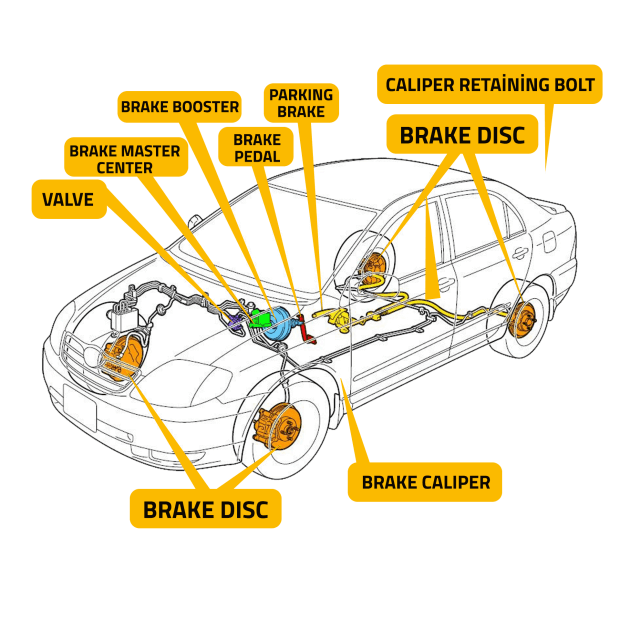
Within a hydraulic braking system, the driver creates force through the compression of the brake pedal. This force is then amplified through the pedal, booster, and master cylinder. The driver adjusts the pedal pressure to bring the vehicle to a stop between 20 and 120 pounds. Humans need to use their senses to safely stop the vehicle.

Vacuum Brake Booster
The booster increases pedal force, allowing for a lower mechanical pedal ratio. A lower pedal ratio shortens pedal travel and allows for better modulation. Most vacuum-assisted vehicles have a mechanical pedal ratio of 3.2:1 to 4:1. The size of the booster diaphragm and the amount of vacuum generated by the engine determine the amount of assist provided. Most engines generate a vacuum of approximately -8 psi (not to be confused with inches of mercury). Assuming a booster with a 7-inch diaphragm and -8 psi engine vacuum, it will produce over 300 pounds of additional assist.

15-905501 JCB brake servo
Friction and Fluids
Clamping force and the coefficient of friction are on one side of the equation, while braking torque is on the other. Increasing either variable changes the amount of torque the system can produce.
Clamping force is used to generate friction, which in turn generates torque to stop the vehicle. At this juncture, the “coefficient of friction” proves to be useful. Here, the “coefficient of friction” proves to be useful. To determine the coefficient of friction, one divides the force needed to glide an object over a surface by the object’s mass. Take, for instance, a scenario where sliding a 1-pound brake pad over a rotor requires 1 pound of force, resulting in a friction coefficient of 1.0 between the materials.
Fundamentally, engineers harmonize the friction coefficient by adjusting the piston and master cylinder sizes to achieve the appropriate braking force and sensation for the vehicle. Adjusting the friction coefficient, whether higher or lower, might disturb this equilibrium.
Reality
In our theoretical examples above, we ignored some real-world factors that influence the amount of clamping force. Most factors that increase pedaling force or travel aren’t hydraulic, but rather mechanical, such as the caliper piston and brake pads. The only constant is the human factor of applying the pedal. Drivers have a limit on how hard they can apply the pedal, and their brains have a limit on how quickly they can react in an emergency. If both the brain and the feet are battling a problem with the brake pads or hydraulics, hopefully a solution can be found before an accident occurs.
For brake distributors, stocking quality components—from vacuum brake boosters to friction-optimized pads—ensures customer safety and repeat business. Pro Tip: Audit your inventory for 15-905501-compatible systems!


